What Right Is Implied by the Second Amendmentã¢â‚¬â„¢s Right to Bear Arms?
The Second Amendment & the Correct to Acquit Arms
History of the Second Subpoena
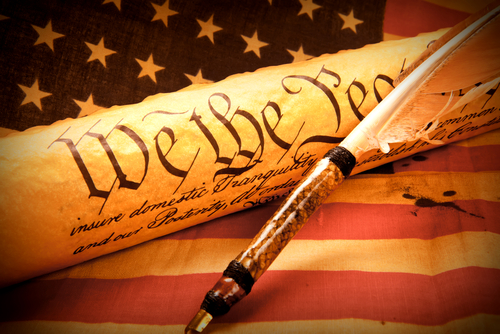
The 2nd Amendment provides U.S. citizens the right to behave artillery. Ratified in December 1791, the subpoena says:
A well regulated Militia, being necessary to the security of a free Land, the correct of the people to keep and deport Artillery, shall not be infringed.
James Madison originally proposed the Second Subpoena shortly subsequently the Constitution was officially ratified as a style to provide more power to state militias, which today are considered the National Guard. Information technology was deemed a compromise between Federalists — those who supported the Constitution equally it was ratified — and the anti-Federalists — those who supported states having more ability. Having merely used guns and other arms to ward off the English, the amendment was originally created to give citizens the opportunity to fight back confronting a tyrannical federal government.
Interpretations of the Second Amendment
Since its ratification, Americans accept been arguing over the amendment's meaning and interpretation. One side interprets the amendment to mean information technology provides for collective rights, while the opposing view is that it provides individual rights.
Those who take the collective side remember the subpoena gives each state the right to maintain and railroad train formal militia units that can provide protection confronting an oppressive federal government. They contend the "well regulated militia" clause clearly means the correct to comport arms should only be given to these organized groups. They believe this allows for only those in the official militia to acquit guns legally, and say the federal regime cannot abolish land militias.
Those with the reverse viewpoint believe the amendment gives every denizen the right to ain guns, complimentary of federal regulations, to protect themselves in the confront of danger. The individualists believe the amendment's militia clause was never meant to restrict each citizen's rights to bear arms.
Both interpretations take helped shape the land's ongoing gun control debate. Those supporting an individual'southward right to own a gun, such as the National Rifle Clan, debate that the Second Amendment should give all citizens, not just members of a militia, the right to own a gun. Those supporting stricter gun command, like the Brady Campaign, believe the 2nd Amendment isn't a bare cheque for anyone to ain a gun. They feel that restrictions on firearms, such every bit who tin have them, under what conditions, where they tin can be taken, and what types of firearms are available, are necessary.
The Supreme Court and the Second Amendment
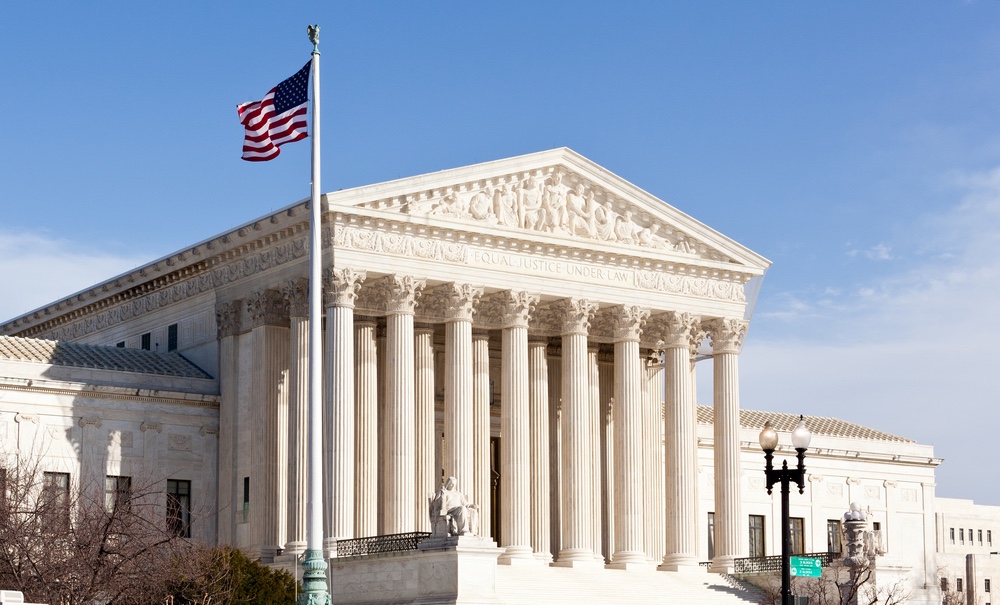
While the right to comport arms is regularly debated in the court of public opinion, it is the Supreme Court whose stance matters most. Notwithstanding despite an ongoing public boxing over gun ownership rights, until recent years the Supreme Court had said very little on the issue.
One of the first rulings came in 1876 in U.South. five. Cruikshank. The instance involved members of the Ku Klux Klan not allowing blackness citizens the correct to standard freedoms, such equally the right to assembly and the right to carry arms. As part of the ruling, the court said the right of each individual to bear arms was not granted under the Constitution. X years later, the courtroom affirmed the ruling in Presser v. Illinois when it said that the 2d Amendment only limited the federal authorities from prohibiting gun ownership, not usa.
The Supreme Court took upwards the issue once again in 1894 in Miller v. Texas. In this case, Dallas' Franklin Miller sued the state of Texas, arguing that despite state laws saying otherwise, he should have been able to carry a concealed weapon under Second Amendment protection. The court disagreed, saying the Second Amendment does non apply to state laws, like Texas' restrictions on carrying unsafe weapons.
All 3 of the cases heard before 1900 cemented the court's opinion that the Nib of Rights, and specifically the Second Amendment, does not prohibit states from setting their own rules on gun buying.
Until recently, the Supreme Court hadn't ruled on the Second Amendment since U.S. v. Miller in 1939. In that case, Jack Miller and Frank Layton were arrested for carrying an unregistered sawed-off shotgun beyond land lines, which had been prohibited since the National Firearms Human activity was enacted 5 years before. Miller argued that the National Firearms Act violated their rights nether the Second Amendment. The Supreme Court disagreed, notwithstanding, saying "in the absence of whatever evidence tending to show that possession or utilise of a 'shotgun having a barrel of less than eighteen inches in length' at this fourth dimension has some reasonable relationship to the preservation or efficiency of a well regulated militia, we cannot say that the Second Subpoena guarantees the correct to go on and acquit such an musical instrument."
Information technology would be about 70 years before the court took up the issue again, this time in the District of Columbia v. Heller in 2008. The case centered on Dick Heller, a licensed special police office in Washington, D.C., who challenged the nation's capital'southward handgun ban. For the first fourth dimension, the Supreme Court ruled that despite country laws, individuals who were non part of a state militia did take the correct to comport artillery. Every bit office of its ruling, the courtroom wrote, "The 2nd Subpoena protects an individual right to possess a firearm unconnected with service in a militia, and to use that arm for traditionally lawful purposes, such as cocky-defence within the home."
The court would rule on the result again two years later as part of McDonald v. City of Chicago, which challenged the metropolis's ban on individual handgun ownership. In a like 5-to-4 ruling, the court affirmed its determination in the Heller case, saying the 2nd Amendment "applies equally to the federal government and the states."
In 2016, the Supreme Court again ruled on a correct-to-conduct-artillery example, Caetano v. Massachusetts. The case involved a woman who was in possession of a stun gun for self-defense against an abusive ex-boyfriend. Because stun guns were illegal under Massachusetts law, the adult female was arrested and convicted for possessing the weapon. The case made its manner to the Supreme Court, which ruled that stun guns and, indeed "all instruments that constitute bearable arms," are protected under the Second Amendment.
In 2017, the Supreme Court declined to hear Peruta v. California, a gun-rights case centering effectually concealed conduct, or the right to carry a curtained handgun in public. California requires that applicants for a curtained acquit license prove "good cause," such as a specific threat to a person's rubber. A Vietnam veteran named Edward Peruta challenged this requirement equally a curtailment of his Second Amendment rights. While Heller was a case well-nigh keeping firearms in the domicile for cocky-protection, Peruta v. California was about whether that right extends to the public sphere. Justice Clarence Thomas and new justice Neil Gorsuch dissented from the refusal to review the case, indicating that the Supreme Courtroom'southward newest justice may exist particularly conservative on gun rights.
Meanwhile, the battle over gun rights continues at the state level. A 2016 working paper from Harvard Business School researchers constitute that a mass shooting leads to a 15 percent increase in the number of firearm-related bills introduced into the state legislature that year. The more than fatalities, the larger the increment in firearm bills. Just the bills aren't always what you might await: When Republicans hold power in the state legislature after a mass shooting, the number of laws enacted to loosen gun restrictions goes upwardly 75 percent. Democrat-controlled legislatures, on the other hand, did not enact a higher rate of regulation-tightening laws immediately after mass shootings than before.
"This is consequent with survey prove suggesting that even when a majority supports a gun-control proposal, those opposed to increased gun control are more likely to take actions like writing a letter of the alphabet or donating money to support their side," the researchers wrote.
Despite the recent rulings, the contend on gun command continues. Incidents similar those in Aurora, CO and Sandy Hook in Newtown, CT only serve as motivation for both sides to have their opinions heard and considered.
Related:
- Obama Gun Proposals Praised by Scientists
- How the Regime Stifled Gun Research
- What is an Assault Weapon?
- What is Liberty?
Editor'south Note: This reference commodity was first published on Jan. 22, 2013. It was updated with new cases and data on June 26, 2017.
Source: https://www.livescience.com/26485-second-amendment.html
0 Response to "What Right Is Implied by the Second Amendmentã¢â‚¬â„¢s Right to Bear Arms?"
Post a Comment